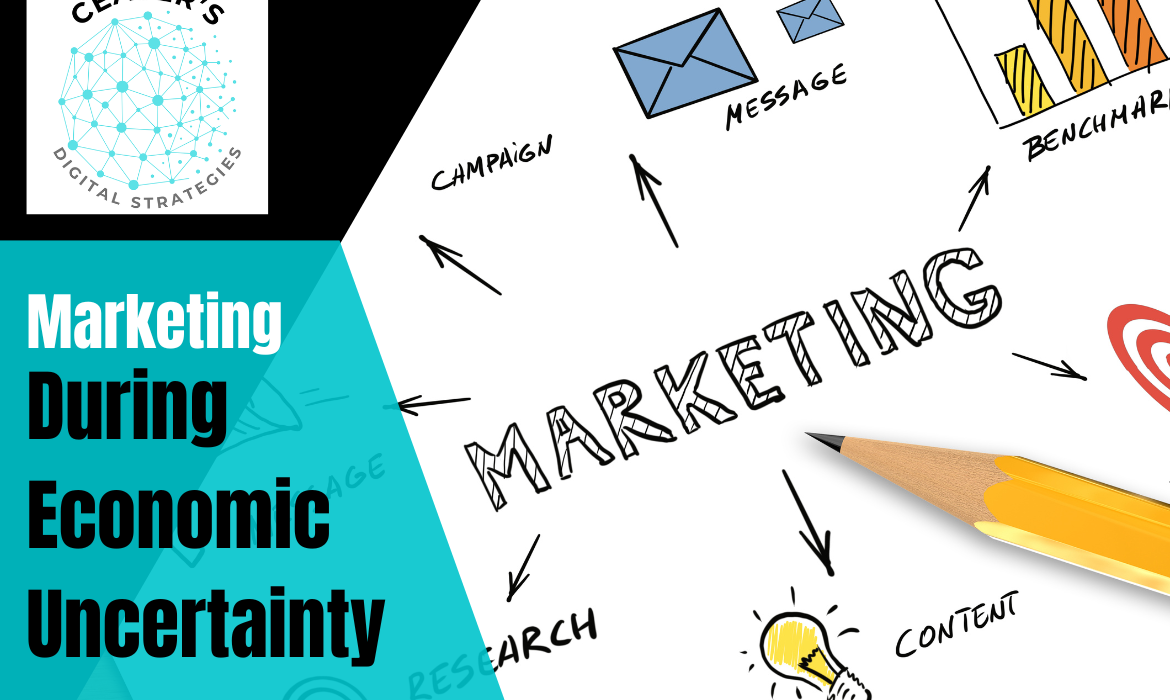
Cutting your marketing budget in a downturn usually hurts long term growth. Keeping a smart marketing plan running during bad economic times lowers your marketing costs, increases visibility, and helps your business win market share and better leads while competitors go quiet.
Economic downturns and recessions are tough on everyone. Customers tighten their belts, and businesses scramble to cut costs. The knee-jerk reaction for many leaders is to slash the marketing budget.
If customers are spending less, it can feel logical to go quiet and wait for better days. The problem is that history and data tell a very different story. The brands that maintain or even increase their marketing during times of economic uncertainty usually emerge far stronger than those that disappear.
In fact, marketing in a recession can be a secret weapon. It can turn a small business into a local leader, help a regional bank outgrow national competitors, or let an ecommerce brand capture loyal customers for years to come.
This guide will walk through why continuing to market during economic uncertainty is a smart move. We will look at how marketing costs behave in a downturn, how visibility translates into leads and market share, and what real world case studies teach us. Then we will close with practical digital marketing and small business marketing strategies you can put to work right now.
Marketing in economic uncertainty means using your marketing budget strategically even when the economy looks shaky. It is not about ignoring reality or spending blindly. It is about staying visible, helpful, and memorable while others pull back.
For a small business in and around Des Moines, that might look like:
In other words, you do not stop marketing. You adjust your message, sharpen your offers, and use every dollar more carefully.
When revenue softens, marketing can look like the easiest line item to cut. It is flexible, unlike rent or payroll. You can pause your ads or cancel a sponsorship with a simple email.
On paper, cutting marketing costs can make your profit and loss statement look healthier for a quarter or two. The problem shows up later. Over the next one to three years, a business that goes quiet usually sees:
Customers do not stop needing products or services during a recession. They simply become more selective and more value focused. If your brand disappears from their feed, inbox, and search results, they forget about you faster than you might think. A competitor who keeps marketing can step into your place and become the brand they trust.
Marketing is also cumulative. It builds memory structures in the minds of your customers. Turning off your marketing is not like turning off a light that you can flip back on. It is more like stepping out of a conversation, then trying to jump back in months later and hoping no one drifted away.
Cutting marketing may feel safe. In reality, it often locks in slower growth just when you need momentum the most.
Here is the counterintuitive good news: marketing can actually become cheaper during bad economic times.
When the economy slows, many companies pull back on advertising. That sudden drop in demand for ad inventory has a very practical effect. Media companies and platforms still need to sell space, so they often:
You can:
In plain English, a times of economic uncertainty is often the moment when well planned marketing becomes a bargain.
Let us talk about what all of this means for market share, lead generation, and revenue.
Share of voice is the portion of all advertising in your category that comes from your brand. If you run 10 percent of the marketing activity in your space, you have roughly 10 percent share of voice.
In a downturn, something interesting happens. Many competitors cut their marketing budgets. If you keep yours steady, your share of voice naturally rises, even if you never increase your spending.
Over time, there is a strong connection between share of voice and market share. Brands that maintain a share of voice higher than their current market share usually grow faster. The math is simple. If customers see and hear from you more than from your competitors, you get more chances to:
For a small or mid sized business, especially in a local market, that increased share of voice shows up in very practical ways:
All of that translates into stronger lead generation. While other businesses are invisible, you are present. When the economy swings back, you have already built relationships that competitors will have to chase.
This principle is not just theory. It has played out again and again over the last century in very different industries. Here are some of the most powerful examples.
Before the Great Depression, Post was the dominant ready to eat cereal brand in the United States. When the crisis hit, Post did what seemed financially conservative. It cut its advertising budget.
Kellogg’s went in the opposite direction. It doubled its ad spend, invested heavily in radio, and promoted Rice Krispies with the memorable Snap, Crackle, and Pop characters.
Despite the worst economic environment of the century, Kellogg’s profits climbed. By the mid 1930s, Kellogg’s had overtaken Post and become the category leader. It held that position for decades. A bold marketing budget during a downturn reshaped an entire industry.
During the same era, Procter & Gamble faced the same brutal conditions as other consumer brands. Instead of disappearing, it sponsored daily radio dramas aimed at homemakers. These series were so closely tied to P&G’s soap brands that the term “soap opera” was born.
Those shows gave stressed families free entertainment and comfort. P&G kept investing in marketing costs while also adding value for its audience. When the economy recovered, the company was top of mind in living rooms across America.
In the 1930s, many car companies vanished. Chevrolet, part of General Motors, stuck with its marketing and dealer support strategy. While others slipped into the background, Chevy emphasized durability and value. The result was stronger brand loyalty during a shrinking market and a bigger slice of demand when buyers returned.
In the 1970s, a different downturn hit the auto world. Fuel prices spiked, inflation rose, and consumers sought more efficient vehicles. Some American manufacturers pulled back on marketing and focused inward.
Toyota did not. It continued to invest in U.S. marketing, highlighting fuel efficiency and reliability. While many domestic brands looked slow or out of touch, Toyota showed up with the right message at the right time. It climbed the import rankings, overtaking Volkswagen (who also pulled marketing spend) and set the stage for decades of global growth.
In the Midwest, the 1980s farm crisis is still remembered as a painful chapter. Land values collapsed, interest rates soared, and many farms went under. Demand for new equipment shrank dramatically.
John Deere chose not to disappear. The company maintained a visible presence, worked closely with dealers, and kept communicating with farmers. It offered financing options, service support, and ongoing innovation.
By continuing to invest in marketing and relationships instead of hiding, John Deere reinforced its role as a long term partner. When the farm economy improved, many producers rewarded that loyalty by staying with or switching to John Deere.
The early 1990s recession created a famous cautionary tale. During that downturn, McDonald’s decided to reduce its advertising. Two competitors, Pizza Hut and Taco Bell, saw an opening and increased their own marketing.
The results were not subtle:
The lesson was painful but clear. Saving on marketing costs in the short term had a much higher cost in lost revenue and share. By the time of the Great Recession years later, McDonald’s had changed its approach. It leaned into value focused marketing instead of going dark and weathered the storm more successfully.
During the 2008 to 2009 Great Recession, Amazon launched and heavily promoted the Kindle. While many retailers pulled back, Amazon invested in marketing a new, more affordable way to read and buy books.
The strategy worked. Kindle became a breakout hit and helped solidify Amazon’s leadership in ecommerce and digital publishing.
In the luxury category, De Beers increased its U.S. advertising while others cut back. It positioned diamonds as meaningful, fewer but better purchases during a time when many people were buying less. Holding its marketing budget in a collapsing category helped De Beers maintain share and brand prestige.
In consumer electronics, Sony cut back on advertising significantly. Samsung did not. Samsung kept launching new products and marketing aggressively, especially in TVs and smartphones. Over time, Samsung took the lead in categories where Sony used to be the default choice. Marketing through the downturn helped rewrite the leaderboard.
These stories all share the same pattern. When times are good you should be marketing. When times are bad you NEED to be marketing.
By now, you can see the pattern. Cutting marketing costs is rarely a winning move. The next question is practical: how should you adjust your small business marketing in a downturn?
You should keep advertising, but you may need to shift your message. In tough times, customers care more about:
That does not mean you need to sound gloomy. In fact, scare tactics often backfire. A better approach is:
For example, a local bank in Iowa might focus on financial education, stability, and personal guidance.
In a downturn, it usually makes sense to put more attention on:
That might mean:
Remember that it is usually cheaper to keep a customer than to acquire a new one. Use your marketing to deepen relationships, not just chase fresh leads.
There is no single magic channel, but some tactics tend to offer especially strong value when budgets are tight.
Digital marketing is usually more measurable and flexible than most traditional media. That matters when every dollar has to work.
Smart options include:
For businesses in Iowa and similar markets throughout the Midwest, this combination of SEO, content, PPC, email, and social can be a powerful, efficient marketing system during any downturn.
A focused small business lead generation plan in bad economic times might include:
You do not have to spend like a national brand. You simply need to be more visible and more helpful than the competitors in your neighborhood who pulled back.
One of the advantages of marketing in lean times is that it exposes what truly works. When every customer is more selective, the campaigns that still perform are the ones you should pay attention to.
Track things like:
Look for patterns. If a particular message, offer, or channel keeps generating leads and sales, protect that budget. If something slows down, test a new message or shift those dollars to the winners.
Stay aware of what your competitors are doing. If they reduce their presence in any channel, you have a chance to expand into the space they leave behind.
Tough economic times test the nerve of every business owner and marketing leader. It is natural to want to retreat and cut anything that feels optional.
The evidence, however, points to a different path. The brands that stay visible with smart, empathetic marketing not only survive downturns. They often come out of them stronger, with more loyal customers and a bigger share of the market.
For businesses in Iowa and across the Midwest, whether you are a local bank, an ag equipment dealer, a professional services firm, a manufacturer, or a digital storefront, the principle holds. Do not let fear make you invisible.
You do not have to spend recklessly. You do need to keep communicating, keep showing up, and keep giving your audience clear reasons to choose you. If you want help building that kind of plan, connect with Ceaser’s Digital Strategies to talk about how we can turn economic uncertainty into economic opportunity for your small or medium sized business.
Economic downturns eventually end. When they do, the question is simple:
Will your business be starting over from the back of the pack, or leading the way because you chose to keep marketing when others decided to disappear?
When the going gets tough, the tough keep advertising. Embrace that mindset and you will not just survive a downturn. You will be ready to grow because of it.
In most cases, no. Cutting your marketing budget entirely might ease short term cash flow, but it usually damages long term growth. A better approach is to refine your message, focus on your highest impact channels, and keep a consistent presence while competitors go quiet.
There is no single percentage that fits every business, but many small businesses find that holding a stable marketing budget in the range they used during normal times, then reallocating toward the best performing channels, provides better results than large cuts. The key is to track performance closely and move budget toward campaigns that generate qualified leads and revenue.
Digital marketing tends to perform well because it is measurable and flexible. SEO, content marketing, PPC, email, and social media can all deliver good results when used together. Local search optimization is especially important if you serve a specific region. Traditional channels can also work, but they often require a larger minimum spend.
Focus on solving urgent problems and providing clear value. Create content that answers the questions your customers are asking, offer helpful tools or resources in exchange for email addresses, and continue to follow up with leads over time. Emphasize offers that help customers save money, reduce risk, or make smarter decisions. Lead generation may slow, but it does not have to stop


info@ceasersdigitalstrategies.com

128 W Main St, State Center,
IA, 50247, United States
At Ceaser’s Digital Strategies, we are committed to long-term, sustainable growth for our clients. Our approach is tailored to meet the unique needs of your business, ensuring customized plans that drive real results.
© 2025 — Ceaser’s Digital Strategies. All Rights Reserved.